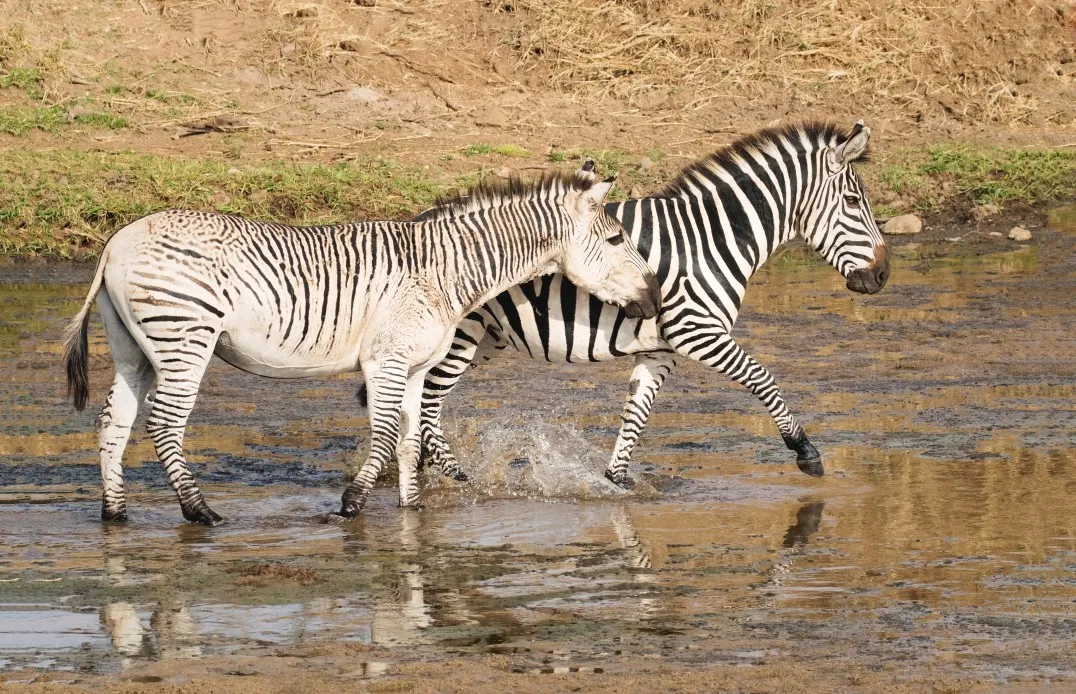
Plains zebra
Equus quagga
- Status: Near Threatened (widely reported)
- Social unit: stable harem
- Stripe pattern: broad, variable
- Note: quagga recognized as a southern subspecies lineage
Zebra safari guide. Updated February 13, 2026
Compare the strongest zebra safari destinations, from classic migration plains to northern Kenya, and use the guide to choose the right route.
As of early 2026, the three zebra species track very different conservation realities: plains zebras remain widespread but have declined from historical baselines; mountain zebras show recovery in parts of southern Africa; and Grevy's zebra remains Endangered with a restricted range in Kenya and Ethiopia.
Primary sources: IFAW (zebra facts), Marwell studbook (Grevy).
Estimates vary by method and year. Values here are presented as a practical dashboard for the 2024-2026 window.
Safari planning
If the guide is turning into trip planning, start with the routes that best match plains zebra sightings or a stronger Grevy's zebra angle.
A practical route when you want zebra-heavy savannah days and a strong base for customizing northern Kenya.
See zebra safari Migration plainsA better fit if you want broad plains zebra sightings in classic Tanzania migration country.
Open itinerary Grevy's focusGet a custom Kenya plan built around Samburu, Laikipia, and the landscapes most relevant to Grevy's zebra.
Request a safariZebras are extant members of the genus Equus. Across the three species, chromosomal and ecological differences shape social systems, range use, and how drought pressure plays out on the ground.
Equus quagga
Equus zebra
Equus grevyi
| Feature | Plains | Mountain | Grevy |
|---|---|---|---|
| Chromosomes | 44 | 32 | 46 |
| Average weight | 220-322 kg | 240-370 kg | 350-450 kg |
| Max speed | ~65 km/h | ~60 km/h | ~64 km/h |
| Primary social unit | stable harem | stable harem | territorial / fission-fusion |
Zebras are hindgut fermenters that can process tough grasses. Their grazing can open up forage for more selective herbivores, supporting savanna grazing succession.
The strongest current support points to biting-fly deterrence as a primary functional driver of zebra stripes.
Key reading: University of Bristol, Ig Nobel (flies).
Key reading: UC Davis summary.
Suggested reading: WCS photo story.
The major drivers are drought extremes, habitat fragmentation, and direct offtake (meat + skin trade), with the highest risk concentrated in Grevy's range.
Zebra conservation is increasingly landscape-driven: data, corridors, and community rangeland governance. For Grevy's zebra, Kenya remains the pivot.
Suggested reading: Grevy's Zebra Trust (report).
The quagga was a southern plains zebra lineage with reduced striping and a brownish coat. The Quagga Project selectively breeds living plains zebras with quagga-like coat traits to recover a similar phenotype ("Rau Quaggas"). This can recover aspects of appearance, but it does not recreate the extinct population's full ecological history.
Official reference: quaggaproject.org.
Zebra-only images from our library. Click a photo to open it larger.
2 photos - tip: click any image to zoom.
A short source list for the key figures and claims on this page. Links open in a new tab.